I just got back from a lovely rendezvous with Sam and Shari, two of my really good friends from the good ol' days of living at the Middle East Coexistence House at Rutgers. They're two of my favorite people to spend time with because they are both ever-curious and adventurous, always have exciting stories to share, and are usually (much like me) undergoing the exciting and terrifying crisis of what to do next in life.
For many of us early and mid-twenty-somethings here in New York, the options and opportunities are endless to the point of being overwhelming. Elizabeth Gilbert (author of Eat Pray Love--don't judge me) wasn't kidding when she said that if she had to choose one word to describe New York and New Yorkers it would be "ambition." We have a complete disdain for wasting time, are constantly surrounded by social, cultural, and educational stimuli, change our minds on an almost weekly basis about where we want to go with our careers, and yet feel pressured to make instant decisions. It's a frighteningly mind tingling combination, which leaves some of us up way past bed-time blogging about its causes, side effects, and consequences.
Liberal Arts Education. It teaches us critical thinking, how to read, how to write, and how to be interested in everything we learn. Then it sends us off (often without too many practical skills) into the world to look for jobs. For those of us who end up in New York, an absolute mecca for liberal arts graduates, we want to see everything, do everything, learn everything, and go everywhere. When we end up with a desk job straight out of college, we feel lost. Then the wanderlust kicks in, and whatever satisfaction we may have had with what we actually have in the here and now fades to the background as we dream of all the things we could be doing. And I think that this often breeds some kind of dissatisfaction as a result. I get the feeling that we're almost bred now to get bored easily, get excited quickly, and do a billion things at once, and, when we take a moment to rest--feel useless or wasteful. The phenomenon seems to leave many of us somewhat dysfunctional when it comes to relationships, always a little unavailable, and kind of like satellites to the suburbs or elsewhere in the country, where people our age may be settling down a bit more.
The strange thing is, that as much as it sounds like I'm criticizing this phenomenon I am also totally in love with it, and myself perpetually float in and out of it. That feeling of dissatisfaction itself feels so busy and so deep, like on its own it breeds ideas and opportunities for the future, that it ends up being motivational instead of disquieting. And so I don't dwell on it for long. Then again, I'm also lucky to have certain supportive, exciting, wonderful people in my life who keep me happy with what I have now while passionate and curious about the future. This balance keeps me from entering into a cycle of chasing one apparent dream to the next across the world until I find myself without a career at the age of 40, and STILL without any direction, although...come to think of it....that could be fun?
Friday, April 8, 2011

Tuesday, February 2, 2010
Where does my passion ponder
Where does it plow?
Never too deeply in my bone
For it sticks sweetly to my skin
Flickering fondly and fervently forth
Into my hands as they harvest high heat
Emanating from my ebullient embankment of a brain
Onto the paper I write upon,
I pensively play precious pranks
On my own voracious vivid and vast heart
How hard do you beat, high heart?
Whom do you beckon to bereave you of breath?
Do they know whose precious passion they prey upon?
And how much are you worth
Without the willingness to work for the withheld
For the unfortunate, unable to unearth their freedom?
Come close, passionate piece, passionate peace.
Make yourself music. Make yourself mighty. Make mend.
Where does it plow?
Never too deeply in my bone
For it sticks sweetly to my skin
Flickering fondly and fervently forth
Into my hands as they harvest high heat
Emanating from my ebullient embankment of a brain
Onto the paper I write upon,
I pensively play precious pranks
On my own voracious vivid and vast heart
How hard do you beat, high heart?
Whom do you beckon to bereave you of breath?
Do they know whose precious passion they prey upon?
And how much are you worth
Without the willingness to work for the withheld
For the unfortunate, unable to unearth their freedom?
Come close, passionate piece, passionate peace.
Make yourself music. Make yourself mighty. Make mend.
Saturday, August 9, 2008
A Day in Paradise
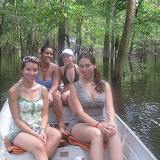
I woke up on Wednesday morning in a light sweat, to new bird calls and to the sound of a buzzing fan. Breakfast is at 7:30 every morning in a beautiful hut by which gorgeous parrots like to laze and communicate. At breakfast I ate the freshest fruit I've ever had in my life: a really deep yellow, sweet and juicy pineapple and thick red watermelon. All bread was freshly baked, with home churned butter and home-made jam, all served with freshly squeezed passion fruit juice. After breakfast my trekking group, made up of six girls and the guide, went back to our cabins to get ready for the full day jungle hike. We wore tank tops, jeans tucked into long socks, sneakers, and caps.
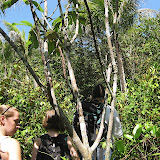
Joanna and Joseph led us into the jungle once again. The Amazon Rainforest during the day looks very much like it does on the Discovery Channel, only being there feels like being in a completely different universe. It never occurred to me that the things I see on National Geographic and on the Discovery Channel, in all those beautiful photos, is truly real. There in the Amazon Rainforest, walking past medicinal and poisonous plants, careful not to step on armies of leaf-cutting ants, and trying to avoid snakes, I finally realized how incredible it feels to discover nature. I knew it was moving all around me; there were thousands of snakes I couldn't see and wildlife I would never discover, which could recognize my scent from afar.
We stopped many times along our trek so that our guides can explain the functions of various plants. We found trees which when cut a certain way, release about ten liters of fresh drinking water, and a tree whose bark is used in anti - malarial medicine. We also came across many unique flowers, one with long tubular yellow petals and another with blue buds that looked like blueberries. We even did a little bit of bush-whacking! At one point we ventured off the trail into an unexplored part of the jungle, where we spotted an anteater really high up in a tree. A while later, after having hiked for a while longer through the miraculous jungle, Natasha noticed a snake ready to strike right next to Yolanda’s ankle. She called out to the guides, and Joseph came over to get the snake out of the way; he picked it up and explained that this is one of the most poisonous snakes in the Amazon Rainforest. One bite from it can shut down a human’s nervous system. I have an overwhelming fear of snakes, but somehow looking at it coiling from Joseph’s hand I overcame my fear and took very close photos of it. I couldn’t believe how well camouflaged it was! Had Natasha not spotted it moving, it may have struck Yolanda’s ankle. Joanna told us later that our group is incredibly lucky for having seen the wildlife that we did; anteaters are particularly difficult to spot.
We hiked for three hours before coming to a cleared bit of land in the jungle where the eco-lodge built its “rest area”. Here we waited for the other trekking group to come and have lunch with us. We were so hot by this point that we got down to our underclothing and washed ourselves in the stream. The water in this stream is also safe for drinking. Joanna doesn’t even bring bottled water when she hikes, because she just drinks directly from the fresh water sources in the jungle. When the other group arrived, we relaxed and dined on barbequed meets and fresh fruit. Upon finishing lunch, our guides informed us that we had two options. We could either take the long and more arduous route back to our eco-lodge, or take a shorter, less intensive route back. I opted to take the longer route. This time we were led by Evo, a young Dutch reptilian expert.
After having only hiked a few meters back through the Rainforest, Evo spotted a bullet ant making its way up a tree. A bullet ant is large and extremely poisonous; one bite and the infected area will become paralyzed for twenty-four hours, and the pain will feel much like that caused by a bullet. Evo had just been bitten by one recently and described how he could not move his arm for an entire day. Amidst intense bush-whacking we began to hear thunder. My heart pounded in anticipation of rain. One of the experiences I had been looking forward to most is rain the Rainforest. The wind came first. Millions of leaves up ahead rustled, making a loud chattering noise. Then the rain came down. Hard. Suddenly the rain forest came even more alive with sound. We hiked through the applause of jungle rain for a half hour more before coming out near a lake. The lake glistened and sparkled with raindrops; wet, sweaty, and hot we said nothing before running towards the water. We stripped down to our bras, underwear, and boxers once again and ran into the lake. Swimming in the lake was like taking a warm bath, only we were surrounded by rainforest. We spent about forty five minutes in the water just relaxing and having races from one side of the lake to the other. The rain stopped and a light fog formed over the top of the lake. I felt like I was in a movie, and at that moment I really missed Nick. The scene was incredibly romantic, but it was missing the protagonist couple. Instead we frolicked in the lake and I had the time of my life in a paradise I don’t think I will ever be able to accurately describe.
Joanna and Joseph led us into the jungle once again. The Amazon Rainforest during the day looks very much like it does on the Discovery Channel, only being there feels like being in a completely different universe. It never occurred to me that the things I see on National Geographic and on the Discovery Channel, in all those beautiful photos, is truly real. There in the Amazon Rainforest, walking past medicinal and poisonous plants, careful not to step on armies of leaf-cutting ants, and trying to avoid snakes, I finally realized how incredible it feels to discover nature. I knew it was moving all around me; there were thousands of snakes I couldn't see and wildlife I would never discover, which could recognize my scent from afar.
We stopped many times along our trek so that our guides can explain the functions of various plants. We found trees which when cut a certain way, release about ten liters of fresh drinking water, and a tree whose bark is used in anti - malarial medicine. We also came across many unique flowers, one with long tubular yellow petals and another with blue buds that looked like blueberries. We even did a little bit of bush-whacking! At one point we ventured off the trail into an unexplored part of the jungle, where we spotted an anteater really high up in a tree. A while later, after having hiked for a while longer through the miraculous jungle, Natasha noticed a snake ready to strike right next to Yolanda’s ankle. She called out to the guides, and Joseph came over to get the snake out of the way; he picked it up and explained that this is one of the most poisonous snakes in the Amazon Rainforest. One bite from it can shut down a human’s nervous system. I have an overwhelming fear of snakes, but somehow looking at it coiling from Joseph’s hand I overcame my fear and took very close photos of it. I couldn’t believe how well camouflaged it was! Had Natasha not spotted it moving, it may have struck Yolanda’s ankle. Joanna told us later that our group is incredibly lucky for having seen the wildlife that we did; anteaters are particularly difficult to spot.
We hiked for three hours before coming to a cleared bit of land in the jungle where the eco-lodge built its “rest area”. Here we waited for the other trekking group to come and have lunch with us. We were so hot by this point that we got down to our underclothing and washed ourselves in the stream. The water in this stream is also safe for drinking. Joanna doesn’t even bring bottled water when she hikes, because she just drinks directly from the fresh water sources in the jungle. When the other group arrived, we relaxed and dined on barbequed meets and fresh fruit. Upon finishing lunch, our guides informed us that we had two options. We could either take the long and more arduous route back to our eco-lodge, or take a shorter, less intensive route back. I opted to take the longer route. This time we were led by Evo, a young Dutch reptilian expert.
After having only hiked a few meters back through the Rainforest, Evo spotted a bullet ant making its way up a tree. A bullet ant is large and extremely poisonous; one bite and the infected area will become paralyzed for twenty-four hours, and the pain will feel much like that caused by a bullet. Evo had just been bitten by one recently and described how he could not move his arm for an entire day. Amidst intense bush-whacking we began to hear thunder. My heart pounded in anticipation of rain. One of the experiences I had been looking forward to most is rain the Rainforest. The wind came first. Millions of leaves up ahead rustled, making a loud chattering noise. Then the rain came down. Hard. Suddenly the rain forest came even more alive with sound. We hiked through the applause of jungle rain for a half hour more before coming out near a lake. The lake glistened and sparkled with raindrops; wet, sweaty, and hot we said nothing before running towards the water. We stripped down to our bras, underwear, and boxers once again and ran into the lake. Swimming in the lake was like taking a warm bath, only we were surrounded by rainforest. We spent about forty five minutes in the water just relaxing and having races from one side of the lake to the other. The rain stopped and a light fog formed over the top of the lake. I felt like I was in a movie, and at that moment I really missed Nick. The scene was incredibly romantic, but it was missing the protagonist couple. Instead we frolicked in the lake and I had the time of my life in a paradise I don’t think I will ever be able to accurately describe.
Friday, August 8, 2008
Welcome to the Jungle!
I wrote this entry on Wednesday, the day after I arrived in Manaus:
Yesterday I finally discovered Brasil. I was on Flight JJ304 from Salvador to Manaus, sitting next to a jovial middle-aged Brasilian man who has been living in New Hampshire for the past seventeen years. I was fortunate enough to have the window seat, and never did it matter more to me than it did on this particular flight. We took off from Salvador and for two hours, Cesar, the jovial Brasilian man, regaled me with tales of his travels and deeply personal experiences. He had come to Brasil for about a month to visit his children from his first marriage, and to research the potential for an import/export company that he was hoping to initiate for the exchange of novelty products between Brasil and the United States. He told me about why he immigrated to the United States (to escape political corruption and economic instability in Brasil), how he gained his citizenship (marrying an American woman whom he had fallen in love with), why he wouldn’t want to live in Brasil again (political corruption), and about his first and second marriages. I told him about the project I’d been working on in Salvador, and was refreshed to hear that he thought our project is a great one. I haven’t been feeling that great about it, so to hear such encouraging things from this random Brazilian man was quite heartening.
We didn’t even notice the time fly by as we spoke, and when the pilot told us to prepare for landing, we locked our eyes onto the world outside of my window. As the plane descended, I realized we were flying directly over the Black River, which mixed with the Amazon River at a very distinct point where you could even see the line where the brown river becomes blue. Even from thousands of feet high, I could see how the Amazon is the largest river in the world, and I took pictures of its grandeur. We descended further, and as we flew over land I could see the tops of trees belonging to the Amazon Rainforest. When the plane landed, I still felt like I was zooming deeper and deeper into the Amazon and its Rainforest. I still feel like I’m zooming in further and further, only the focus becomes clearer the deeper I go.
Upon arriving at the Manaus Airort, we quickly grabbed our luggage, and boarded the bus meant to transport us directly to our eco-lodge, located two hours away from the Airport. I sat next to Taylor at the very front of the bus, and we talked about our family histories for a while, before I got bored and decided to play the Cube Game on him. The Cube Game is an old Sufi psychological test and fortune telling game meant to reveal the testee’s attitude towards and ways of dealing with the world around him or her. A participant can only play once in a lifetime, because the participant cannot know anything about the contents of the game before playing. I did a really good job interpreting Taylor’s results, and he went to the back of the bus to tell other people about it. I watched the Rainforest fly by my window and listened to music. I even fell asleep, only to awake to find out that our bus has broken down. We stopped at a gas station, and sat outside in the scorching heat for about an hour and a half waiting for another bus. The hour and a half actually turned out to be very refreshing. For the first time, stranded in the middle of nowhere, with a gorgeous view of the rainforest in the distance, I felt like I was truly somewhere new. We walked to a hut across the street where a kind old woman sold beer, water, and trinkets and we bought beer to cool us down while we waited for the new bus to arrive. I didn’t get to relax for very long, though, because a few members from our group sought me out to Cube them. I was booked for a full hour Cubing one person after another. It was a really fun and almost surreal experience to be there in the middle of nowhere, telling fortunes ( and even more surreal to discover I’m good at it ;) )
The new bus was larger, and by the time and hour and a half was up we were ready to get going to our eco-lodge. Our Brazilian driver played an American 80’s music CD that he had made himself for the duration of our trip to the eco-lodge, as he sped wildly on the road. We blasted the music as we flew past the Amazon Rainforest, sunset, and many other cars. It felt like we had our own badass soundtrack, marking the introduction to a thrilling story about adventure, danger, and love.
We arrived at our eco-lodge at about seven p.m. It is called Amazonat, and is essentially an environmentally and ecologically friendly resort in the middle of the Amazon Rainforest. The guides met us and took us to the dining area, a beautiful open hut with a great view of the surrounding forest. He told us we’d be having dinner, and that there is an optional spider trek that would be taking place directly after dinner. We ate an incredibly delicious and fresh meal there, and while most of the group defected and went to bed after dinner, a few girls and I decided we wanted to participate in the spider trek. We went to our cabins, settled in quickly, and then set out into the jungle with our guides. Armed with flashlights and wearing long pants tucked into our socks, we slowly entered the forest. At night the Amazon Rainforest is pitch black, and without flashlights we would not have been able to see anything at all. Yet in the moments I could spare to not be watching the ground for snakes or spiders, I looked up to watch the sky ablaze with the Milky Way and the brightest stars I’ve ever seen. The experience was breathtaking. I didn’t get a chance to see the Rainforest so close during the day, and now I was there for the first time at night, hearing creatures I could not see and imagining what my surroundings really look like. I felt a rush of adrenaline and excitement as we walked through the pitch black Rainforest under the canopy of the glistening sky.
We first came across a couple of capybaras drinking water from a small pond. I found this particularly amusing because Nick and company have been harassing me to try Capybara at restaurants in Bahia, but I could never find it anywhere. No, first I was going to see LIVE capybaras. And of course after seeing them live I don’t think I could ever eat them. They’re adorable! They are giant rodents with cute webbed feet and coarse hair; apparently they take to humans much like dogs. They are the only animals which the eco-lodge keeps as pets. After playing with the capybaras for a while, we went on into the jungle. The guide led us off the trial for about a mile and a half until we finally came across a hole in the ground where Evo, our guide, said the Goliath Bird-eating Spider would be. The Goliath Birdeating spider is the largest spider in the world. It is highly poisonous; when it feels threatened it shoots off hair from its hind, one of which could cause terminal blindness. If it lands anywhere else on your body, the itching and burning sensation is ten times worse than that of poison ivy. The spider itself is larger than my hand. Evo took a long stick and probed it into the hole, causing the Goliath to emerge from its lair. While it ran around its nest for a little while searching for pray, Evo informed us that this particular spider was a female. Female Goliaths are incredibly difficult to mate with. The male Goliath has to be extremely careful when courting the female, for if he does not do it to her liking, she will devour him. My kind of woman! We stood there in awe of her, all the while shuffling our feet so that ants do not swarm our feet.
There is a plethora of ant species in the jungle. The one we came across most frequently is the leaf cutter ant. These ants form trails along which they carry pieces of leaves to their nest. There are worker ants, which are smaller, that carry the leaves to the nest and there are soldier ants which are a bit bigger with larger heads that make sure the worker ants are properly carrying out their function. Neither the soldier ants, nor the worker ants, reproduce. The queen ant is the only ant that reproduces. We had to be very careful not to step on any of the many ant trails that we came across on our way back from the Goliath. As we shone our flashlights on the ground before us we noticed something moving very quickly near the ant trail. Our second guide, Joanna, excitedly informed us that this is a Brazilian Wandering Spider. This happens to be the most venomous spider in the world. Had we not been looking carefully at the ground we may have stepped on it! Joanna skillfully removed it from our path with a long stick and we got out of the jungle and to our cabins without any further life threatening obstructions.
Jen, Kristen, and I went to sleep shortly after getting back from our nighttime jungle excursion. I fell asleep to sounds of crickets, howler monkeys, and sounds I don’t think I could ever identify, with adrenaline still rushing through my veins.
Yesterday I finally discovered Brasil. I was on Flight JJ304 from Salvador to Manaus, sitting next to a jovial middle-aged Brasilian man who has been living in New Hampshire for the past seventeen years. I was fortunate enough to have the window seat, and never did it matter more to me than it did on this particular flight. We took off from Salvador and for two hours, Cesar, the jovial Brasilian man, regaled me with tales of his travels and deeply personal experiences. He had come to Brasil for about a month to visit his children from his first marriage, and to research the potential for an import/export company that he was hoping to initiate for the exchange of novelty products between Brasil and the United States. He told me about why he immigrated to the United States (to escape political corruption and economic instability in Brasil), how he gained his citizenship (marrying an American woman whom he had fallen in love with), why he wouldn’t want to live in Brasil again (political corruption), and about his first and second marriages. I told him about the project I’d been working on in Salvador, and was refreshed to hear that he thought our project is a great one. I haven’t been feeling that great about it, so to hear such encouraging things from this random Brazilian man was quite heartening.
We didn’t even notice the time fly by as we spoke, and when the pilot told us to prepare for landing, we locked our eyes onto the world outside of my window. As the plane descended, I realized we were flying directly over the Black River, which mixed with the Amazon River at a very distinct point where you could even see the line where the brown river becomes blue. Even from thousands of feet high, I could see how the Amazon is the largest river in the world, and I took pictures of its grandeur. We descended further, and as we flew over land I could see the tops of trees belonging to the Amazon Rainforest. When the plane landed, I still felt like I was zooming deeper and deeper into the Amazon and its Rainforest. I still feel like I’m zooming in further and further, only the focus becomes clearer the deeper I go.
Upon arriving at the Manaus Airort, we quickly grabbed our luggage, and boarded the bus meant to transport us directly to our eco-lodge, located two hours away from the Airport. I sat next to Taylor at the very front of the bus, and we talked about our family histories for a while, before I got bored and decided to play the Cube Game on him. The Cube Game is an old Sufi psychological test and fortune telling game meant to reveal the testee’s attitude towards and ways of dealing with the world around him or her. A participant can only play once in a lifetime, because the participant cannot know anything about the contents of the game before playing. I did a really good job interpreting Taylor’s results, and he went to the back of the bus to tell other people about it. I watched the Rainforest fly by my window and listened to music. I even fell asleep, only to awake to find out that our bus has broken down. We stopped at a gas station, and sat outside in the scorching heat for about an hour and a half waiting for another bus. The hour and a half actually turned out to be very refreshing. For the first time, stranded in the middle of nowhere, with a gorgeous view of the rainforest in the distance, I felt like I was truly somewhere new. We walked to a hut across the street where a kind old woman sold beer, water, and trinkets and we bought beer to cool us down while we waited for the new bus to arrive. I didn’t get to relax for very long, though, because a few members from our group sought me out to Cube them. I was booked for a full hour Cubing one person after another. It was a really fun and almost surreal experience to be there in the middle of nowhere, telling fortunes ( and even more surreal to discover I’m good at it ;) )
The new bus was larger, and by the time and hour and a half was up we were ready to get going to our eco-lodge. Our Brazilian driver played an American 80’s music CD that he had made himself for the duration of our trip to the eco-lodge, as he sped wildly on the road. We blasted the music as we flew past the Amazon Rainforest, sunset, and many other cars. It felt like we had our own badass soundtrack, marking the introduction to a thrilling story about adventure, danger, and love.
We arrived at our eco-lodge at about seven p.m. It is called Amazonat, and is essentially an environmentally and ecologically friendly resort in the middle of the Amazon Rainforest. The guides met us and took us to the dining area, a beautiful open hut with a great view of the surrounding forest. He told us we’d be having dinner, and that there is an optional spider trek that would be taking place directly after dinner. We ate an incredibly delicious and fresh meal there, and while most of the group defected and went to bed after dinner, a few girls and I decided we wanted to participate in the spider trek. We went to our cabins, settled in quickly, and then set out into the jungle with our guides. Armed with flashlights and wearing long pants tucked into our socks, we slowly entered the forest. At night the Amazon Rainforest is pitch black, and without flashlights we would not have been able to see anything at all. Yet in the moments I could spare to not be watching the ground for snakes or spiders, I looked up to watch the sky ablaze with the Milky Way and the brightest stars I’ve ever seen. The experience was breathtaking. I didn’t get a chance to see the Rainforest so close during the day, and now I was there for the first time at night, hearing creatures I could not see and imagining what my surroundings really look like. I felt a rush of adrenaline and excitement as we walked through the pitch black Rainforest under the canopy of the glistening sky.
We first came across a couple of capybaras drinking water from a small pond. I found this particularly amusing because Nick and company have been harassing me to try Capybara at restaurants in Bahia, but I could never find it anywhere. No, first I was going to see LIVE capybaras. And of course after seeing them live I don’t think I could ever eat them. They’re adorable! They are giant rodents with cute webbed feet and coarse hair; apparently they take to humans much like dogs. They are the only animals which the eco-lodge keeps as pets. After playing with the capybaras for a while, we went on into the jungle. The guide led us off the trial for about a mile and a half until we finally came across a hole in the ground where Evo, our guide, said the Goliath Bird-eating Spider would be. The Goliath Birdeating spider is the largest spider in the world. It is highly poisonous; when it feels threatened it shoots off hair from its hind, one of which could cause terminal blindness. If it lands anywhere else on your body, the itching and burning sensation is ten times worse than that of poison ivy. The spider itself is larger than my hand. Evo took a long stick and probed it into the hole, causing the Goliath to emerge from its lair. While it ran around its nest for a little while searching for pray, Evo informed us that this particular spider was a female. Female Goliaths are incredibly difficult to mate with. The male Goliath has to be extremely careful when courting the female, for if he does not do it to her liking, she will devour him. My kind of woman! We stood there in awe of her, all the while shuffling our feet so that ants do not swarm our feet.
There is a plethora of ant species in the jungle. The one we came across most frequently is the leaf cutter ant. These ants form trails along which they carry pieces of leaves to their nest. There are worker ants, which are smaller, that carry the leaves to the nest and there are soldier ants which are a bit bigger with larger heads that make sure the worker ants are properly carrying out their function. Neither the soldier ants, nor the worker ants, reproduce. The queen ant is the only ant that reproduces. We had to be very careful not to step on any of the many ant trails that we came across on our way back from the Goliath. As we shone our flashlights on the ground before us we noticed something moving very quickly near the ant trail. Our second guide, Joanna, excitedly informed us that this is a Brazilian Wandering Spider. This happens to be the most venomous spider in the world. Had we not been looking carefully at the ground we may have stepped on it! Joanna skillfully removed it from our path with a long stick and we got out of the jungle and to our cabins without any further life threatening obstructions.
Jen, Kristen, and I went to sleep shortly after getting back from our nighttime jungle excursion. I fell asleep to sounds of crickets, howler monkeys, and sounds I don’t think I could ever identify, with adrenaline still rushing through my veins.
Thursday, July 31, 2008
Impending Press Conference and Work Summary
Tomorrow is our last day at UFBA, and the day of our Press Conference. We will be our presenting our projects to the press and to various NGO's in the hopes of gaining media attention and support. Funding will not be allocated to the best group because GPACT is a liar, but I have a feeling that by noon tomorrow my group and I will be feeling quite accomplished.
Below I've pasted the Project Description which we will be sending in a huge file along with the rest of our Global Pact Final Packet to the trainers tomorrow. It's a good summary of what we've been doing over the past three weeks and where our project is now in case you would like to read it.
I'll write more tomorrow about why I've been frustrated with a couple of our group members and a few of the complications our project may experience when we leave Brazil.
I am proud to say, however, that after three weeks of solid work in Saramandaia and in Salvador, our project CAN work and is ready for implementation:
Our group has come a long way since the first few days of the Global Pact program. Our project began as we tried to tackle the problem of unemployment within the favelas. Unemployment was extremely broad and difficult to break down because initially we could not see past the issue of a lack of government funding for the development of underrepresented communities. Finally we realized that we were thinking too generally. Upon thinking more specifically, we realized that the lack of skills and the lack of community awareness about work opportunities could also be a problem. We believe that both of these issues could be traced to the lack of a steady flow of information about how to find employment and how to learn valuable skills. By implementing simple communications technologies within Saramandaia, through which information can be shared and passed on, we believe that eventually people will be able to create employment opportunities for themselves as well as learn skills from others within the community. This network will eventually lead to a better overall reputation for Saramandaia, and serve as an inspiration for other underprivileged communities. After listening to and learning from our Brazilian group members, we came up with a much more specific and feasible idea. We decided that it would be more effective to help a project that is already being implemented.
In order to learn more about local development projects, we met with Professor Genauto, a professor at Universidade Federal da Bahia (UFBA). One of his many projects includes working together with students at UFBA to stimulate economic solidarity in and working with projects already in existence within Saramandaia, an underrepresented neighborhood in Salvador. Our research began by traveling to Saramandaia to see first hand where we could be of assistance. After attending a few community meetings, we learned that the project ideas being discussed at the meetings were not being shared with the rest of Saramandaia because the people involved did not have the means to advertise. After some deliberation we decided that we could truly assist this community by initiating a communications project by which Genauto’s project members could spread their ideas to the rest of Saramandaia and to Salvador as well. By tackling a smaller issue like the lack of communications within Saramandaia, the people of Saramandaia will become better equipped to confront larger issues such as unemployment.
At the first community meeting, we learned that there are currently many developmental project ideas being proposed and initiated through a partnership between active community members and Genauto and some of his students. Project goals include organizing the cooperatives already in existence to help stimulate the economy of Saramandaia, to establish a community bank and community currency, and to create an information center through which the people of Saramandaia can have easy access to computers and public information. We were in awe of these incredible initiatives, but we learned that in order for these projects to be successful, the rest of Saramandaia must be aware of them. A community bank with its own currency cannot be successfully established if the people of Saramandaia do not know about it and approve of it. We also learned at this meeting that the radio is the most widely utilized source of information, and that Saramandaia has its own radio station. We realized then that we could potentially partner with whomever runs the radio station to provide the community projects with air time to announce their project ideas and involve the rest of Saramandaia. We also thought that if we could use this radio station to announce community project updates, we could also teach the youth in Saramandaia to use media technology to market their own skills and talents and help engender a new generation that is actively involved in the development of the community.
To continue with our action research, we realized that we needed to meet with associations that already specialize in communication. We first met with CIPÓ, an NGO that trains youth how to advertise and market their skills and talents. We spoke with Bruna, who coordinates communications workshops in various communities near Saramandaia, and asked her for community marketing advice. We told her our project ideas and although she really liked our radio station idea, she said we did not have nearly enough time to implement a youth training program. She also said she would be glad to provide us with various marketing materials, but that CIPÓ does not have the resources to work with Saramandaia because of the many communities it is already involved with.
After the meeting with CIPÓ we decided to focus our efforts on finding the person in charge of the radio station in Saramandaia. We learned through our project member,Ingrid, that Fabio, one of the community youth instructors, knows Antonio, the man who runs the radio. We called Fabio and scheduled a meeting with Antonio. This meeting was the final step in developing our launch project.
Ícone will begin a partnership with Saramandaia´s local radio station to make weekly announcements regarding community meetings and projects. These announcements will hopefully incite community involvement, which in turn will stimulate economic growth within Saramandaia. We have a space in the community where we can establish an office to act as our central headquarters; this is where our group plans to grow and become more of an active catalyst in the communications program. Antonio is very interested in our project idea and is willing to help us become involved in an effort to impact the entire neighborhood consisting of 40,000 people. With the help of Antonio and the cooperation of Saramandaia our organization hopes to develop and explore different educational avenues. Our main long-term goal focuses on educational communications workshops. These workshops will be open to all youth in the neighborhood and will teach them the skills necessary to communicate their ideas in an effective manner. Antonio wants the radio to be very educational and thinks that with our help we can make a difference in the development of Saramandaia.
Below I've pasted the Project Description which we will be sending in a huge file along with the rest of our Global Pact Final Packet to the trainers tomorrow. It's a good summary of what we've been doing over the past three weeks and where our project is now in case you would like to read it.
I'll write more tomorrow about why I've been frustrated with a couple of our group members and a few of the complications our project may experience when we leave Brazil.
I am proud to say, however, that after three weeks of solid work in Saramandaia and in Salvador, our project CAN work and is ready for implementation:
Project Description
Our group has come a long way since the first few days of the Global Pact program. Our project began as we tried to tackle the problem of unemployment within the favelas. Unemployment was extremely broad and difficult to break down because initially we could not see past the issue of a lack of government funding for the development of underrepresented communities. Finally we realized that we were thinking too generally. Upon thinking more specifically, we realized that the lack of skills and the lack of community awareness about work opportunities could also be a problem. We believe that both of these issues could be traced to the lack of a steady flow of information about how to find employment and how to learn valuable skills. By implementing simple communications technologies within Saramandaia, through which information can be shared and passed on, we believe that eventually people will be able to create employment opportunities for themselves as well as learn skills from others within the community. This network will eventually lead to a better overall reputation for Saramandaia, and serve as an inspiration for other underprivileged communities. After listening to and learning from our Brazilian group members, we came up with a much more specific and feasible idea. We decided that it would be more effective to help a project that is already being implemented.
In order to learn more about local development projects, we met with Professor Genauto, a professor at Universidade Federal da Bahia (UFBA). One of his many projects includes working together with students at UFBA to stimulate economic solidarity in and working with projects already in existence within Saramandaia, an underrepresented neighborhood in Salvador. Our research began by traveling to Saramandaia to see first hand where we could be of assistance. After attending a few community meetings, we learned that the project ideas being discussed at the meetings were not being shared with the rest of Saramandaia because the people involved did not have the means to advertise. After some deliberation we decided that we could truly assist this community by initiating a communications project by which Genauto’s project members could spread their ideas to the rest of Saramandaia and to Salvador as well. By tackling a smaller issue like the lack of communications within Saramandaia, the people of Saramandaia will become better equipped to confront larger issues such as unemployment.
At the first community meeting, we learned that there are currently many developmental project ideas being proposed and initiated through a partnership between active community members and Genauto and some of his students. Project goals include organizing the cooperatives already in existence to help stimulate the economy of Saramandaia, to establish a community bank and community currency, and to create an information center through which the people of Saramandaia can have easy access to computers and public information. We were in awe of these incredible initiatives, but we learned that in order for these projects to be successful, the rest of Saramandaia must be aware of them. A community bank with its own currency cannot be successfully established if the people of Saramandaia do not know about it and approve of it. We also learned at this meeting that the radio is the most widely utilized source of information, and that Saramandaia has its own radio station. We realized then that we could potentially partner with whomever runs the radio station to provide the community projects with air time to announce their project ideas and involve the rest of Saramandaia. We also thought that if we could use this radio station to announce community project updates, we could also teach the youth in Saramandaia to use media technology to market their own skills and talents and help engender a new generation that is actively involved in the development of the community.
To continue with our action research, we realized that we needed to meet with associations that already specialize in communication. We first met with CIPÓ, an NGO that trains youth how to advertise and market their skills and talents. We spoke with Bruna, who coordinates communications workshops in various communities near Saramandaia, and asked her for community marketing advice. We told her our project ideas and although she really liked our radio station idea, she said we did not have nearly enough time to implement a youth training program. She also said she would be glad to provide us with various marketing materials, but that CIPÓ does not have the resources to work with Saramandaia because of the many communities it is already involved with.
After the meeting with CIPÓ we decided to focus our efforts on finding the person in charge of the radio station in Saramandaia. We learned through our project member,Ingrid, that Fabio, one of the community youth instructors, knows Antonio, the man who runs the radio. We called Fabio and scheduled a meeting with Antonio. This meeting was the final step in developing our launch project.
Ícone will begin a partnership with Saramandaia´s local radio station to make weekly announcements regarding community meetings and projects. These announcements will hopefully incite community involvement, which in turn will stimulate economic growth within Saramandaia. We have a space in the community where we can establish an office to act as our central headquarters; this is where our group plans to grow and become more of an active catalyst in the communications program. Antonio is very interested in our project idea and is willing to help us become involved in an effort to impact the entire neighborhood consisting of 40,000 people. With the help of Antonio and the cooperation of Saramandaia our organization hopes to develop and explore different educational avenues. Our main long-term goal focuses on educational communications workshops. These workshops will be open to all youth in the neighborhood and will teach them the skills necessary to communicate their ideas in an effective manner. Antonio wants the radio to be very educational and thinks that with our help we can make a difference in the development of Saramandaia.
Friday, July 25, 2008
Bossa Nova
The past few days have been quite frustrating. We have a week to finish up our projects and prepare materials for the Press Conference, which takes place next Friday. Yet we sit in class from 9-5, and I feel that most of that time is spent unwisely. Our trainers spend hours explaining concepts that could be understood in a few minutes; I understand that they're trying to be creative in their long-winded examples, but I think that since we have such limited time to implement a good project, that time would be better spent either working in small groups or going out to do action research. A couple of days ago the Professor noted that a lot of the groups were experiencing frustrations, and so we spent the last two hours of class time that day in a Circle of Truth, where everybody express their aggravations, as well as what they like about either their group members or the program. Most American students voiced that class time was being used unwisely, that a lot of the Brazilian students do not show up every day, and that the program is not as organized as it should be. Many Brazilians complained that the incentives for the Brazilian students to participate are different from the incentives the Americans have. It seems to them that we are there only to get a grade.
This part really bothers me. The program is set up in such a way that the Americans have assignments to complete and presentations to make during the course of the three weeks. Many of the assignments are discussed during class time, and the presentations must include the Brazilians. Yet the Brazilians are not graded for making or participating in the presentations, and they are not obligated to hand in the assignments, so time spent discussing assignments is a waste of their time. I did not come to Brazil for a grade; if I were simply interested in receiving credit, I could have taken summer classes and it would have been much less expensive. So I was doubly disappointed that the Brazilians thought all we care about is grades (especially considering how much commitment I know the Americans in many of the groups are putting into these projects) as well as how uninvolved many of them are being considering its their communities we're working to improve.
A few days ago our group lost an essential group member, Ingrid. Ingrid is in her 30's and has already established an NGO with her husband, which aims to involve street kids in sports as a means for getting them less involved with drugs. She's had tons of experience networking with NGO's and collecting contacts, so she was a very crucial member of our group and contributed a lot of great ideas for NGO's we can contact. She also spoke pretty decent English and helped translate the other Portuguese-speakers. She suddenly told us a couple of days ago that she only has six more days to complete her Ph.D discertation and that she can no longer work with us or with the program. I encouraged my group not to dwell on her absence too much because we can still get a lot done. After the Circle of Truth I think we were all feeling a lot better about the situation, and talked it out the next day. We have a meeting with Antonio, the Saramandia radio man, on Tuesday.
Last night the trainers had a party at their "apartment" and invited us for pizza and drinks. We took a cab over, and I fought with the cab driver because he was trying to heinously rip us off. We walked into their green house and realized that their "apartment" is a gigantic town house with three floors, four hammocks, and an enormous balcony overlooking the ENTIRE city and river. We spent the entire night drinking and dancing on the enormous balcony (large enough to accommodate 40 people) to 70's and 80's music, The Beatles, and Girl Talk. I thought it was a great bonding night for our group. We couldn't stay too late, though, because this morning we took an excursion to Saramandia and had the locals show us around. It was kind of bizarre because they had pretty much rolled out the red carpet for us. They were very proud of the progress they were making in their community, and after our tour they took us to the church where my group and I usually go for meetings and fed us with all sorts of baked goods. As we were leaving the church we were greeted by a small drum troupe which performed for us, and then accompanied us, drummig, all the way to our vans. When we arrived at our vans we were greeted by a very young Capoiera dance troupe. They, too, performed for us before we left to go home. Capoiera is a very popular style dance here. It's a bit difficult to describe, but I think the most accurate way would be to imagine how martial arts would look if it were a dance. Two people enter the circle and shake hands, then they kick over one another's heads and perform all sorts of acrabatic tricks to avoid the other's strike. Then they leave the circle and two others enter. All of this is played out to drumming and singing at the edges of the circle. It's really quite impressive.
Tonight I'm just going to stay in and maybe practice some drawing. James has been trying to teach me to draw cross-country via e-mail. He drew an amazing sketch of Nick from a photograph I sent him, and sent me an instructional e-mail about how to draw Nick. So I attempted it and actually didn't do too bad of a job (for my first time). I've included his version and my version below.
I've also uploaded the first set of Brazil pictures onto my Picasa Website. Check them out: http://picasaweb.google.com/yoolka.d/FirstWeekInBrazil
Oh yes, and in other news, Brazilian Chinese food is superb.
My drawing is on the left, and James's is on the right. I laugh as I look at them side by side; I'm such an amature :P
This part really bothers me. The program is set up in such a way that the Americans have assignments to complete and presentations to make during the course of the three weeks. Many of the assignments are discussed during class time, and the presentations must include the Brazilians. Yet the Brazilians are not graded for making or participating in the presentations, and they are not obligated to hand in the assignments, so time spent discussing assignments is a waste of their time. I did not come to Brazil for a grade; if I were simply interested in receiving credit, I could have taken summer classes and it would have been much less expensive. So I was doubly disappointed that the Brazilians thought all we care about is grades (especially considering how much commitment I know the Americans in many of the groups are putting into these projects) as well as how uninvolved many of them are being considering its their communities we're working to improve.
A few days ago our group lost an essential group member, Ingrid. Ingrid is in her 30's and has already established an NGO with her husband, which aims to involve street kids in sports as a means for getting them less involved with drugs. She's had tons of experience networking with NGO's and collecting contacts, so she was a very crucial member of our group and contributed a lot of great ideas for NGO's we can contact. She also spoke pretty decent English and helped translate the other Portuguese-speakers. She suddenly told us a couple of days ago that she only has six more days to complete her Ph.D discertation and that she can no longer work with us or with the program. I encouraged my group not to dwell on her absence too much because we can still get a lot done. After the Circle of Truth I think we were all feeling a lot better about the situation, and talked it out the next day. We have a meeting with Antonio, the Saramandia radio man, on Tuesday.
Last night the trainers had a party at their "apartment" and invited us for pizza and drinks. We took a cab over, and I fought with the cab driver because he was trying to heinously rip us off. We walked into their green house and realized that their "apartment" is a gigantic town house with three floors, four hammocks, and an enormous balcony overlooking the ENTIRE city and river. We spent the entire night drinking and dancing on the enormous balcony (large enough to accommodate 40 people) to 70's and 80's music, The Beatles, and Girl Talk. I thought it was a great bonding night for our group. We couldn't stay too late, though, because this morning we took an excursion to Saramandia and had the locals show us around. It was kind of bizarre because they had pretty much rolled out the red carpet for us. They were very proud of the progress they were making in their community, and after our tour they took us to the church where my group and I usually go for meetings and fed us with all sorts of baked goods. As we were leaving the church we were greeted by a small drum troupe which performed for us, and then accompanied us, drummig, all the way to our vans. When we arrived at our vans we were greeted by a very young Capoiera dance troupe. They, too, performed for us before we left to go home. Capoiera is a very popular style dance here. It's a bit difficult to describe, but I think the most accurate way would be to imagine how martial arts would look if it were a dance. Two people enter the circle and shake hands, then they kick over one another's heads and perform all sorts of acrabatic tricks to avoid the other's strike. Then they leave the circle and two others enter. All of this is played out to drumming and singing at the edges of the circle. It's really quite impressive.
Tonight I'm just going to stay in and maybe practice some drawing. James has been trying to teach me to draw cross-country via e-mail. He drew an amazing sketch of Nick from a photograph I sent him, and sent me an instructional e-mail about how to draw Nick. So I attempted it and actually didn't do too bad of a job (for my first time). I've included his version and my version below.
I've also uploaded the first set of Brazil pictures onto my Picasa Website. Check them out: http://picasaweb.google.com/yoolka.d/FirstWeekInBrazil
Oh yes, and in other news, Brazilian Chinese food is superb.
My drawing is on the left, and James's is on the right. I laugh as I look at them side by side; I'm such an amature :P


Saturday, July 19, 2008
World at Large
Holy SHIT do I wish I could speak Portuguese. I think I'm adding that to the list of things to do. Portuguese is a beautiful language, and though it is often said that if you speak Spanish you'll be able to understand/speak Portuguese, this is not at all the case. Portuguese sounds like a mixture of French, Spanish, and Italian, but does not sound much at all like Spanish when spoken. I can only see the similarity when it's written down.
My project is going EXTREMELY well. Two days ago our group had an awakening. We knew we wanted to work with unemployment in the Favelas, but our trainers kept telling us the idea was too broad and we were getting frustrated because it almost seemed as though we would have to switch our topic to something more generic. (A favela is a Brazilian shanty-town, where make-shift houses are constructed on public property). As we were mulling over whether or not to switch topics, which I was adamantly arguing against, the trainers informed us that we were receiving a new group member, Ingrid (pronounced Ingridje) who had just joined the class and had the choice of choosing which group to work with. She heard that we were hoping to work with unemployment in the favelas and she joiend our group. As it turns out, she was a Godsend. Not only does she speak very good English and has been a great contribution to our bi-lingual communication efforts, but she also has experience working with NGO's; she and her husband started an NGO to keep children who live in favelas involved in activities to keep them away from drugs and crime. We explained to her that we were having trouble nailing a project idea, and she told us that one thing her NGO has a lot of trouble with is advertising to the community. We thought about this for a while, and decided it might be a really good avenue to try. We spoke to one of the professors at the University about or project ideas, and he told us of a meeting in one of the favelas called Saramnudaia, which would be going on that same night at the favela. The meeting would go from 6-9 and we would have a ride there if we so desired. Without question, we all decided to go to the meeting.
Camila's dad drove us to the meeting right after school. The favela is about a half hour away from the University, and located on an enormous hill looking over all of Salvador, and ironically, the largest mall in Bahia. Driving through the favela for the first time was incredible. On the one hand I looked out the window and saw this gorgeous view of the beautiful city, and on the other I was driving through narrow dirt roads with roofless tin and mudbrick houses on either side of the car. Camila's father dropped us off and we walked to the community Church and meeting house. The Church has two floors; the bottom floor is used for community meetings, and is basically just a room with benches on it. The 2nd floor is the actual Church part of the building, and has a small mural, some candles, and a bunch of benches. Windows adorn the walls with their brilliant views out unto commercial dreams. People were congregating downstairs to discuss a plan initiated by Professor Gianalto and some of the community of Saramundaia to stimulate the economy WITHIN the favela. The idea is to create their own community bank and their own currency in order to ensure that the economy within the community grows, generating both producers and consumers, so that people who were formerly living in absolute poverty could not only eat, but have enough money to start their own small business within the community. The project has been on its way for three months. The room was filled with men and women of all ages, all eager to make the project a reality. They all introduced themselves to us in Portuguese ( after which one of the University students translated to us in English); all of these people were heavily involved in pushing their community forward and creating cooperatives which would spur their economy. Each person in the room was either involved in the agricultural production effort, the Community Bank effort, The Informational Center Research effort, or the Embroidery effort. There were a couple of young guys who were swimming coaches, trying to keep kids off the streets by teaching them how to swim and involving them in fun activities.
I realized at this meeting that my passion is to work with community building. It was unlike anything else I had ever experienced to see these people, with the help of Gianalto and the students, making a solid effort to help themselves. And it was an even greater feeling to know that I could be a part of that. It was absolutely exhiliraitng because I'd never really felt completely passionate about any career-related thing before this meeting, in Saramundaia, in Brazil, on a Tuesday night.
One thing we learned after the meeting was that they definitely needed help communicating their efforts to the rest of Saramundaia, because approval of the whole community would be necessary in order to start up this Community Bank. The problem is that door-to-door canvassing would be too invasive and town newsletters wouldn't work because the majority of the community is illiterate. As I was walking to the car on the way back from the meeting, I noticed a radio in almost all of the make-shift houses. The next day as our group was discussing the previous night before our project ideas presentation, I told Ingrid about the radios I'd noticed. I suggested the possibility of creating a pirated radio station where the Cooperatives can communicate their developments to the rest of the community, so that the community can stay informed and get involved. Everyone REALLY loved the idea, and Ingrid even said there may already be a pirated radio station, which would make things even easier. We are going back on Tuesday night to learn more about how the radio system works in the community. I am SUPER excited.
Last night we went back into the Pehlourinho, met a crazy British dude whose been traveling through Brazil for the past five and a half months and told some increidble stories, hung out at a bar for a few hours, and then came home. There wasn't any dancing in the streets last night. There was one really strange, memorable incident, though. Our large group was gathered around a long table in the main square, and Kristen was eating a sandwich on the corner of the table. One of the begger kids came up to me and started snorting in my ear, then made his way around the table, snorting, to Kristen and asked her for her sandwich. She refused to give it to him, but naiively gave him the paper it was wrapped in. He started licking the paper, and then stuffing it into his mouth, all the while pointing to the sandwich Kristen was holding. She kept refusing, and he stuffed more and more of it into his mouth until he had chewed up the entire paper. Finally, as Kristen was taking a bite of her sandwich, he regurgitated it back at her and walked way.
Today was the first day we havent had any class, but we had an excursion go Playa de Foche, which is a beach about two hours from here where they also have a Sea Turtle Refuge. So we checked out the AWESOME turtles and then hung out on the beach all day. It was a LOT of fun, and I think I'm getting a pretty good tan.
In other news, I have some sort of inefction in my mouth. Hopefully it's going away now that I have antibiotics, but yesterday it was maximally bad. It was really adorable, though, because a few of the Brazilians whom I've befriended were helping me call doctors and getting the phone numbers for hospitals and medications.
I love Brazil!
My project is going EXTREMELY well. Two days ago our group had an awakening. We knew we wanted to work with unemployment in the Favelas, but our trainers kept telling us the idea was too broad and we were getting frustrated because it almost seemed as though we would have to switch our topic to something more generic. (A favela is a Brazilian shanty-town, where make-shift houses are constructed on public property). As we were mulling over whether or not to switch topics, which I was adamantly arguing against, the trainers informed us that we were receiving a new group member, Ingrid (pronounced Ingridje) who had just joined the class and had the choice of choosing which group to work with. She heard that we were hoping to work with unemployment in the favelas and she joiend our group. As it turns out, she was a Godsend. Not only does she speak very good English and has been a great contribution to our bi-lingual communication efforts, but she also has experience working with NGO's; she and her husband started an NGO to keep children who live in favelas involved in activities to keep them away from drugs and crime. We explained to her that we were having trouble nailing a project idea, and she told us that one thing her NGO has a lot of trouble with is advertising to the community. We thought about this for a while, and decided it might be a really good avenue to try. We spoke to one of the professors at the University about or project ideas, and he told us of a meeting in one of the favelas called Saramnudaia, which would be going on that same night at the favela. The meeting would go from 6-9 and we would have a ride there if we so desired. Without question, we all decided to go to the meeting.
Camila's dad drove us to the meeting right after school. The favela is about a half hour away from the University, and located on an enormous hill looking over all of Salvador, and ironically, the largest mall in Bahia. Driving through the favela for the first time was incredible. On the one hand I looked out the window and saw this gorgeous view of the beautiful city, and on the other I was driving through narrow dirt roads with roofless tin and mudbrick houses on either side of the car. Camila's father dropped us off and we walked to the community Church and meeting house. The Church has two floors; the bottom floor is used for community meetings, and is basically just a room with benches on it. The 2nd floor is the actual Church part of the building, and has a small mural, some candles, and a bunch of benches. Windows adorn the walls with their brilliant views out unto commercial dreams. People were congregating downstairs to discuss a plan initiated by Professor Gianalto and some of the community of Saramundaia to stimulate the economy WITHIN the favela. The idea is to create their own community bank and their own currency in order to ensure that the economy within the community grows, generating both producers and consumers, so that people who were formerly living in absolute poverty could not only eat, but have enough money to start their own small business within the community. The project has been on its way for three months. The room was filled with men and women of all ages, all eager to make the project a reality. They all introduced themselves to us in Portuguese ( after which one of the University students translated to us in English); all of these people were heavily involved in pushing their community forward and creating cooperatives which would spur their economy. Each person in the room was either involved in the agricultural production effort, the Community Bank effort, The Informational Center Research effort, or the Embroidery effort. There were a couple of young guys who were swimming coaches, trying to keep kids off the streets by teaching them how to swim and involving them in fun activities.
I realized at this meeting that my passion is to work with community building. It was unlike anything else I had ever experienced to see these people, with the help of Gianalto and the students, making a solid effort to help themselves. And it was an even greater feeling to know that I could be a part of that. It was absolutely exhiliraitng because I'd never really felt completely passionate about any career-related thing before this meeting, in Saramundaia, in Brazil, on a Tuesday night.
One thing we learned after the meeting was that they definitely needed help communicating their efforts to the rest of Saramundaia, because approval of the whole community would be necessary in order to start up this Community Bank. The problem is that door-to-door canvassing would be too invasive and town newsletters wouldn't work because the majority of the community is illiterate. As I was walking to the car on the way back from the meeting, I noticed a radio in almost all of the make-shift houses. The next day as our group was discussing the previous night before our project ideas presentation, I told Ingrid about the radios I'd noticed. I suggested the possibility of creating a pirated radio station where the Cooperatives can communicate their developments to the rest of the community, so that the community can stay informed and get involved. Everyone REALLY loved the idea, and Ingrid even said there may already be a pirated radio station, which would make things even easier. We are going back on Tuesday night to learn more about how the radio system works in the community. I am SUPER excited.
Last night we went back into the Pehlourinho, met a crazy British dude whose been traveling through Brazil for the past five and a half months and told some increidble stories, hung out at a bar for a few hours, and then came home. There wasn't any dancing in the streets last night. There was one really strange, memorable incident, though. Our large group was gathered around a long table in the main square, and Kristen was eating a sandwich on the corner of the table. One of the begger kids came up to me and started snorting in my ear, then made his way around the table, snorting, to Kristen and asked her for her sandwich. She refused to give it to him, but naiively gave him the paper it was wrapped in. He started licking the paper, and then stuffing it into his mouth, all the while pointing to the sandwich Kristen was holding. She kept refusing, and he stuffed more and more of it into his mouth until he had chewed up the entire paper. Finally, as Kristen was taking a bite of her sandwich, he regurgitated it back at her and walked way.
Today was the first day we havent had any class, but we had an excursion go Playa de Foche, which is a beach about two hours from here where they also have a Sea Turtle Refuge. So we checked out the AWESOME turtles and then hung out on the beach all day. It was a LOT of fun, and I think I'm getting a pretty good tan.
In other news, I have some sort of inefction in my mouth. Hopefully it's going away now that I have antibiotics, but yesterday it was maximally bad. It was really adorable, though, because a few of the Brazilians whom I've befriended were helping me call doctors and getting the phone numbers for hospitals and medications.
I love Brazil!
Subscribe to:
Posts (Atom)


 Posts
Posts

